14 Stained Glass Window Ideas That Add Color, Light, and Character to Any Home
Stained glass works beautifully in a modern home when you treat the window as a design decision instead of a decorative afterthought. The projects that succeed share three things: a style that matches the home’s architecture, a placement that respects both light and privacy, and a budget chosen before you fall in love with a panel. Get those right, and a stained glass window reads as custom and intentional. Get them wrong, and it reads as a theme. Here are fourteen ways to use stained glass around the house — plus what it really costs, where to find panels, and a renter-friendly alternative that skips the contractor entirely.

How to Choose the Right Stained Glass for Your Home
Before picking a design, answer three questions. First, what style does your house already speak? Geometric and Prairie-style glass suit craftsman and midcentury homes; flowing botanical or Art Nouveau glass suits traditional and farmhouse interiors; abstract and monochrome linear designs suit contemporary spaces. Second, do you need privacy or a view? Textured, opalescent, and heavily patterned glass hide the view while keeping the light — which makes them natural ways to cover windows without curtains. Clear beveled glass keeps your sightline intact. Third, what’s the budget? Prefabricated panels run about $90–$250 per square foot installed, antique panels $100–$500, and fully custom work $250–$600according to HomeGuide’s published cost ranges Decide the tier first; it shapes every choice below.
Leaded-Glass Transom Above the Front Door
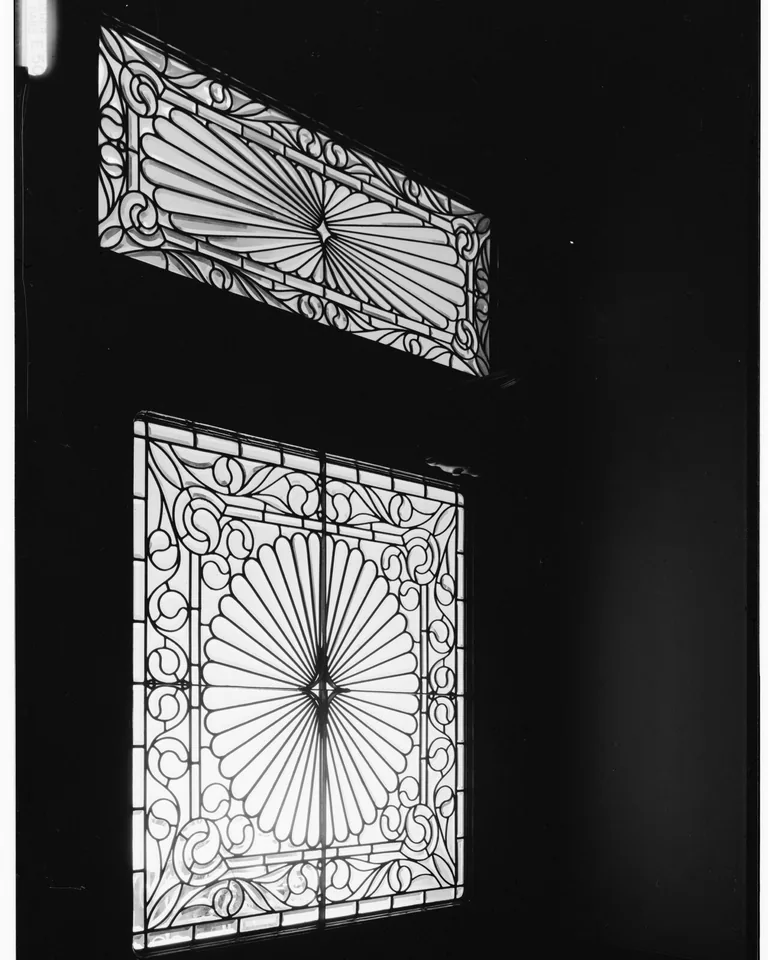
A horizontal transom window above the entry door is one of the highest-impact, lowest-risk places for stained glass. The panel sits above eye level, so even a bold pattern never overwhelms the room, and it throws colored light deep into the hallway every sunny morning. Simple leaded geometric grids or a restrained amber-and-clear design work best here — the entry already has a door, hardware, and lighting competing for attention. Trade-off: transoms in older homes can be single-pane and drafty. Ask your installer about adding a protective outer glazing panel; it shields the artwork and improves energy performance without changing the look from inside.
Geometric Privacy Glass in the Bathroom

Bathrooms are where stained glass earns its keep functionally, not just decoratively. A geometric panel with frosted or opalescent sections gives you full privacy while keeping the daylight — no blinds, no curtains, no fogged glass that feels institutional. Cool palettes (pale blue, sea green, soft gray) read spa-like; warm ambers suit vintage fixtures. For palettes that play well with colored glass, these beige-and-gold bathroom ideas show how warm neutrals keep a small bath feeling calm. Practical note: glass in a shower zone must sit behind clear tempered safety glass, per industry guidance. Outside the shower, standard installation is fine.
Art Deco Fanlight Over Double Doors
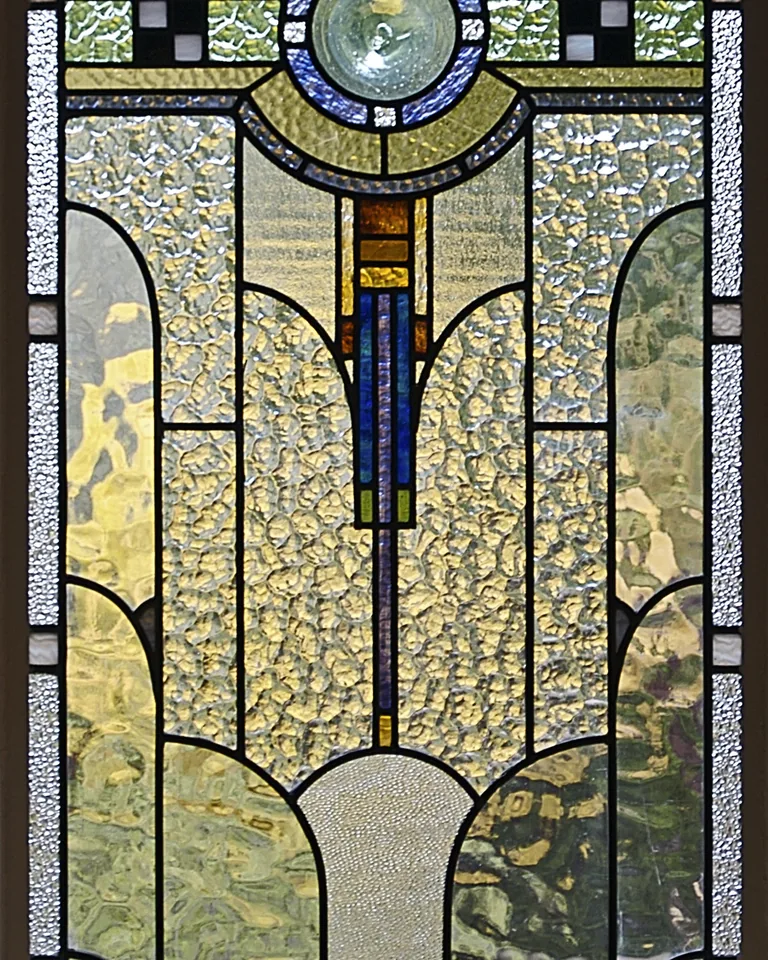
A fan-shaped window radiating from a central point above a pair of doors is pure 1920s geometry — stepped borders, strong radial lines, amber and smoky green glass — and it instantly gives a formal entry or dining room an architectural identity. This design lives on symmetry, so keep everything around it aligned: matching trim profiles, centered hardware, balanced wall molding. The pattern is loud enough on its own that the surrounding walls should stay quiet — solid paint or simple paneling, not competing wallpaper. Tip: if a true curved fanlight is out of budget, a rectangular transom with a fan motif painted or filmed into the design reads surprisingly close at a fraction of the price.
Prairie-Style Sidelights Flanking a Craftsman Entry
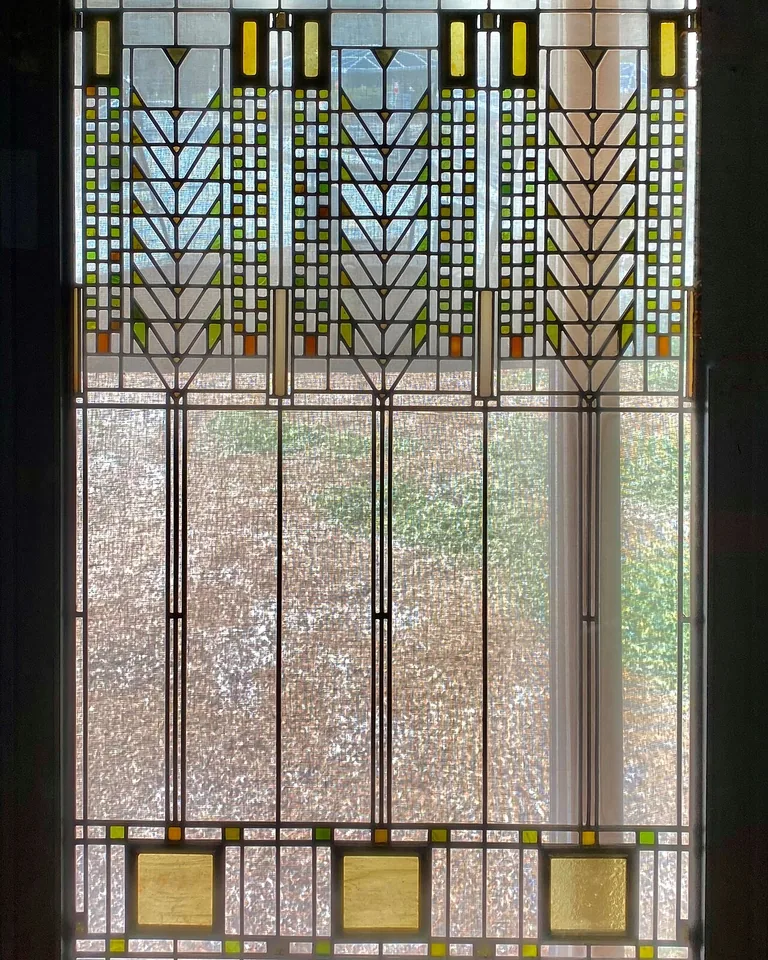
Frank Lloyd Wright’s Prairie style — long horizontal lines, square motifs, restrained amber and sage accents — was practically invented for craftsman and midcentury entries. Sidelights on one or both sides of the front door extend the architecture’s horizontal rhythm and give a dark hallway daylight with complete privacy. The geometry does the talking, so keep nearby finishes calm: natural woodwork, dark bronze hardware, a simple runner. The one rule that matters here is consistency — let the glass supply the pattern and resist the urge to add a second decorative motif within ten feet of the door.
Beveled Clear Glass Over the Kitchen Sink
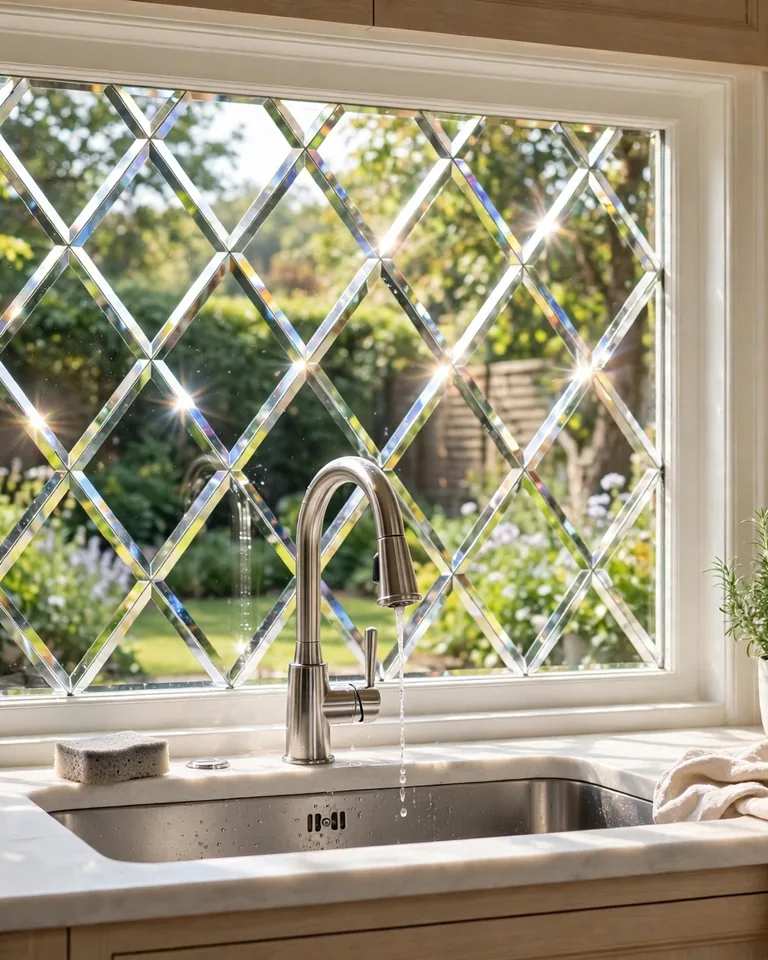
If you love your garden view but the window feels plain, clear beveled glass is the answer. Bevels catch sunlight and throw small rainbows across the counter without blocking a single sightline — all the sparkle of stained glass with zero color commitment. A simple border of bevels around a clear center pane is the classic version; it suits every cabinet style from shaker to modern slab. Because there’s no pattern to coordinate, this is also the easiest panel to pair with the rest of the kitchen — see these kitchen window ideas for styling the trim, sill, and surrounding wall once the glass is in.
Diamond-Lattice Leaded Casements in the Dining Room

Diamond-patterned leadwork brings cottage character through repetition rather than color — small panes of clear or subtly textured glass set in a painted timber frame. It reads as original-to-the-house even when it’s brand new, which makes it ideal for dining rooms in colonial, Tudor, and farmhouse-style homes. Scale matters: smaller diamonds feel busier and suit large windows with plain walls nearby; larger diamonds read calmer and hold their own against patterned rugs or busy woodwork. This is also one of the most restoration-friendly options — a good glass shop can replicate the grid to match existing windows elsewhere in the house.
Oversized Abstract Panel as a Living Room Focal Point

In a contemporary living room, one large abstract panel — irregular color fields in muted blue, amber, and clear glass — can replace a gallery wall entirely. The trick is negative space: leave generous clear or lightly textured sections between the stronger color blocks so the composition reads as intentional rather than chaotic. Hang it (or build it in) where it gets direct light for at least part of the day; abstract glass without strong backlight looks flat. If your living room has a big bay window, coordinate carefully — these bay window curtain pairings show how to dress the surrounding windows so they support the glass instead of fighting it.

Monochrome Linear Glass in a Minimalist Interior

Not every stained glass window needs jewel tones. A monochrome design — clear, softly smoked, and lightly textured glass divided by fine dark lines — adds architecture to a minimalist room without adding color. Line weight is the whole design here: delicate interior divisions keep the window light, while one confident outer border frames the opening. Push the interior lines too heavy and a modest window starts reading as a security grille. This style is at home in Scandinavian and contemporary interiors, and it ages well because there are no trendy colors to fall out of love with.
Gothic Arch Glass on the Stairwell Landing

A tall pointed-arch window on a stairwell landing turns the most overlooked wall in the house into its architectural moment. Deep blues, muted reds, and amber glass against pale plaster, with the staircase’s rising line drawing the eye upward, create drama that needs no furniture to support it. Proportion is everything: the window needs enough surrounding wall to read as an arch, and the handrail shouldn’t slice across its strongest details. Keep the railing simple and the wall finish quiet. Gothic glass has strong historical associations, so use it once per house — a second arch window tips the balance from character to costume.
Wildflower Botanical Glass Over the Kitchen Sink

For farmhouse and cottage kitchens, a botanical panel with loose wildflower clusters — small pink and amber blooms on green stems, mostly clear glass between them — adds personality without turning the sink wall into a mural. The composition rule: keep the flower clusters near the edges and upper portion, leaving the central view open. That keeps the window decorative while preserving the sightline you actually use. A garden beyond the glass makes the design feel connected to its setting; facing a neighbor’s siding, the same panel just looks busy. Check the view first.
Stained Glass Cabinet Doors in the Butler’s Pantry
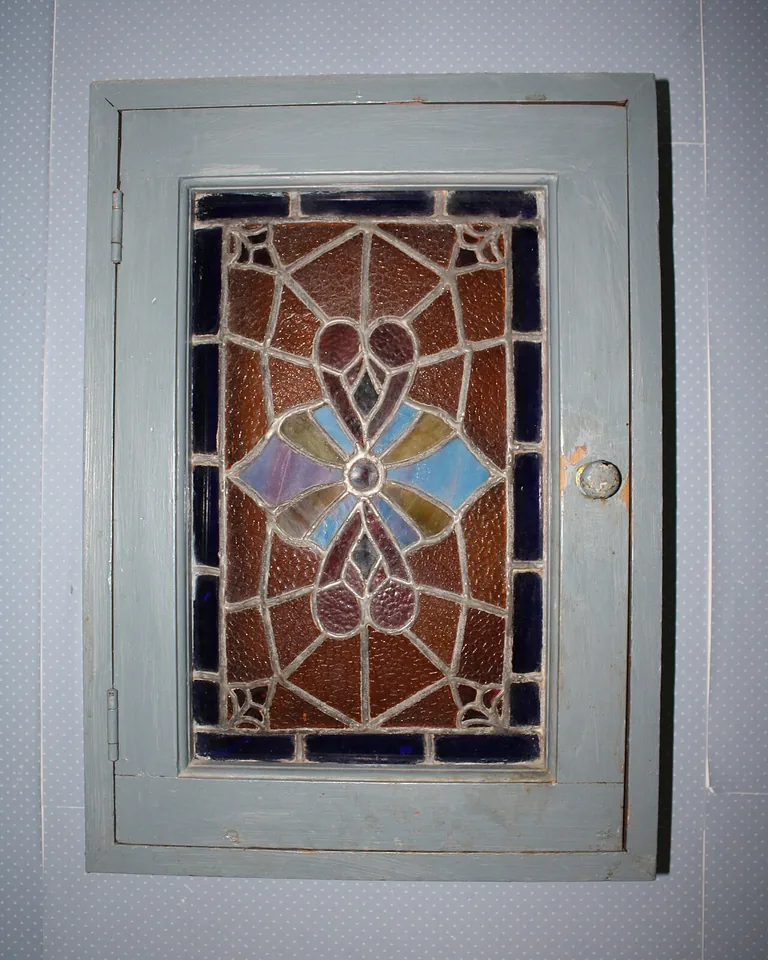
You don’t need a window at all. Replacing a few upper cabinet doors — in a butler’s pantry, bar nook, or glass-front hutch — with small stained glass panels hides cluttered shelves behind something beautiful and bounces light around a windowless corner. Simple geometric or single-motif panels work best at this scale; intricate scenes get lost behind dishes anyway. Because the panels are small, this is also the cheapest way to commission custom work — a local glass artist can often make a pair of cabinet inserts for the price of one large window, and it’s a good first project if you’ve never hired a glass studio before.
Celestial Moon-and-Stars Glass in the Bedroom

A deep-blue panel scattered with amber stars and a crescent moon turns a bedroom window into a night sky that glows at dusk. It works best in rooms where you want the window to feel decorative after dark rather than transparent — guest rooms, kids’ rooms, or a primary bedroom with blackout shades behind it for actual sleep. Keep the rest of the room’s palette restrained: the glass supplies all the drama the room needs. One caution: strong blue and amber light in the evening can tint everything in the room, so test with a small sample panel against your wall color before committing to a full window.
Soft Pastel Glass in a Nursery or Guest Room
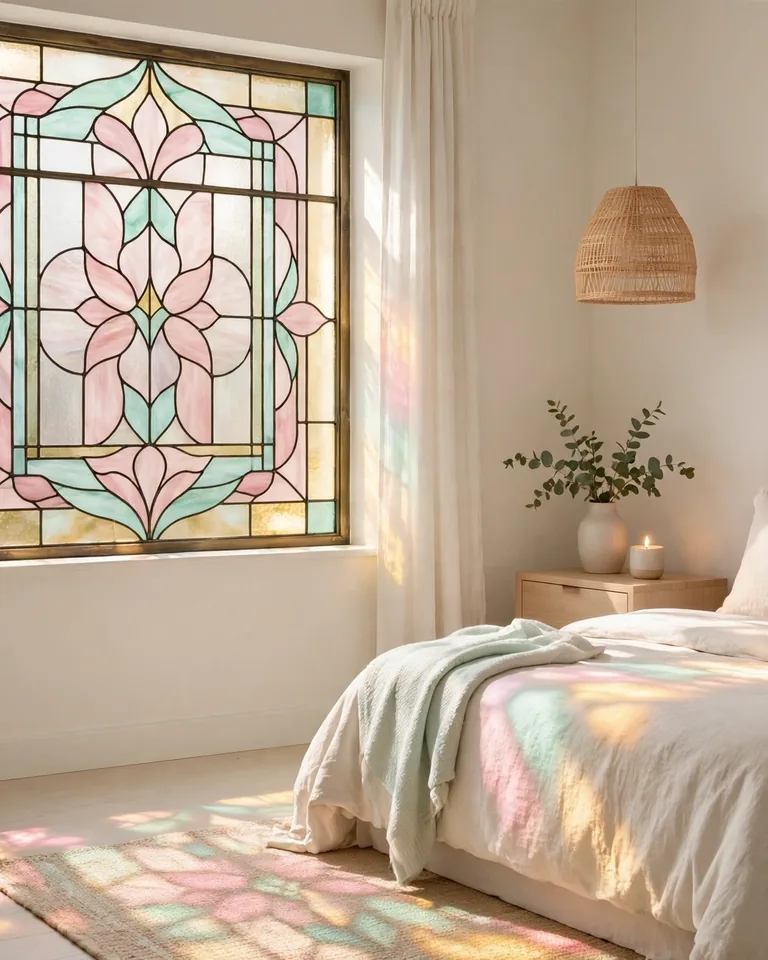
Pastel stained glass — blush pink, mint, pale gold — gives a nursery or guest room a gentle glow without the visual weight of saturated color. The soft palette plays well with white furniture and light textiles, and because pastels diffuse light rather than color it strongly, the room stays bright. This is a good spot for a simple border-only design: a plain center pane with a pastel patterned border delivers the effect while keeping costs down, since most of the panel is inexpensive clear glass. Border designs are also easy to retrofit into an existing window without a full replacement.
Peel-and-Stick Stained Glass Film for Renters
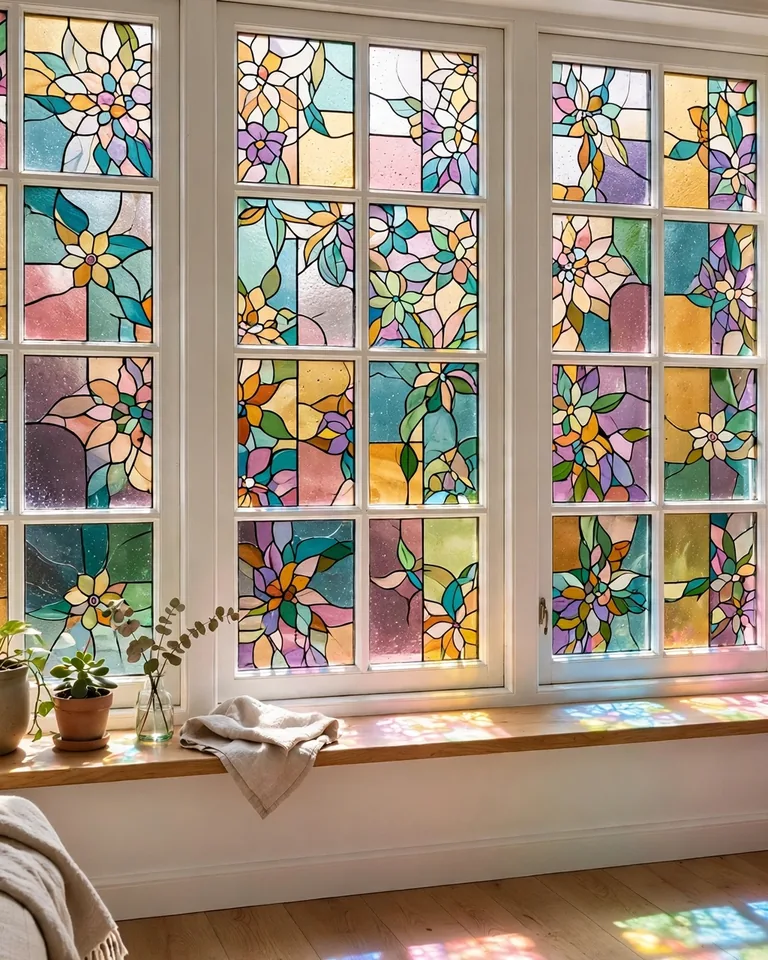
Real leaded glass isn’t always an option — rentals, tight budgets, or a window you might change your mind about. Static-cling stained glass film delivers the look for a fraction of the price, installs in an afternoon with a spray bottle and a squeegee, and peels off cleanly when you move. Be honest about the trade-off: up close, film reads as printed, not handcrafted, and it won’t throw the same depth of colored light as real glass. It excels at privacy glass for bathroom and street-facing windows, where the texture reads beautifully from a few feet away. If you’d rather make the look yourself, these painted glass window designs are another afternoon-scale project with a handmade feel.
What Stained Glass Costs and Where to Buy It
Budget by tier, installed: prefabricated panels $90–$250 per square foot, antique panels $100–$500, custom designs $250–$600 (HomeGuide, 2026 cost data). Prefab panels from home-improvement stores and online retailers are the fastest route for standard sizes. Antique panels come from salvage yards, flea markets, and architectural salvage dealers — measure carefully, since sizes are fixed. Custom work goes through local stained glass studios and artisan galleries; ask to see installed work and get the lead time in writing, since complex designs can take months. Expect a well-made panel to last 75–150 years, so amortized over its life, even custom glass is cheap per year.
Stained Glass Window FAQs
Do stained glass windows look outdated in modern homes?
No — the style makes the difference. Geometric, abstract, and monochrome linear designs read as contemporary, and modern glass artists have largely moved past the heavy Victorian florals people associate with old churches. Matched to the home’s architecture, stained glass looks custom rather than dated.
How much do stained glass windows cost?
Expect $90–$600 per square foot installed, depending on type: roughly $90–$250 for prefabricated panels, $100–$500 for antique panels, and $250–$600 for fully custom designs. Small accent panels and window film cost far less, making them good entry points.
Are stained glass windows energy efficient?
They can be. Many modern installations sandwich the stained glass between double or triple glazing, which protects the artwork and brings the window’s insulation close to a standard modern window. Always discuss glazing options with your installer rather than assuming a single decorative pane.
How do you clean stained glass windows?
Start with spot cleaning using distilled water and a soft cloth. For stubborn residue, use a non-abrasive, pH-neutral cleaner — never ammonia or vinegar, which can damage leading and painted details. Clean gently; the panels are artwork, not regular glazing.
Can you put a stained glass window in a bathroom?
Yes — bathrooms are one of the most popular placements because the glass provides privacy while keeping natural light. For a window inside a shower enclosure, the stained glass must be protected by a separate pane of clear tempered safety glass.
Where can I buy stained glass windows?
Antique stores, flea markets, and architectural salvage dealers for vintage panels; custom glass studios and artisan galleries for bespoke designs; home-improvement stores and online retailers for prefabricated panels in standard sizes.
Quick Checklist Before You Buy
- Match the glass style to your home’s architecture — geometry for modern and craftsman, botanical for traditional, abstract for contemporary.
- Decide privacy versus view before choosing glass texture; textured and opalescent glass hides the view, clear beveled glass keeps it.
- Set the budget tier first: prefab, antique, custom, or film.
- Measure the opening precisely and confirm the frame can carry the panel’s weight.
- For bathrooms and showers, plan privacy glass and tempered safety protection where required.
- Get custom lead times in writing — intricate designs can take months.
- Clean with distilled water and pH-neutral cleaners only; skip ammonia and vinegar.